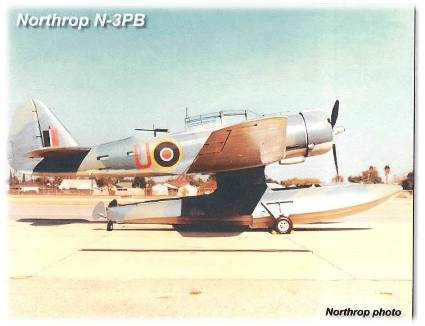
Restored Northrop N-3PB No. 320-"U" Patrol Bomber
at the Hawthorne Municipal Airport after restoration
Northrop N-3PB Specifications
Manufacturer Northrop Aircraft, Inc., Hawthorne, CA
Number Built 24
Wing Span 48 feet, 11 inches
Overall Length 38 feet
Overall Height 12 feet
Wing Area 376.8 sq. feet
Takeoff Weight 10,600Ibs.
Speed - Maximum 257 mph
Speed - Cruising 215 mph
Range 1,400 miles
Service Ceiling 28,400 feet
Powerplant Wright Cyclone, Air Cooled, Radial, 1200 hp
Armament (4) 50-cal guns, (2) 30-cal guns, (1) 2,000
torpedo, or equivalent weight of bombs
The Northrop N-3PB No. 320-"U" Story
On April 25th 1941 the first Norwegian Naval Squadron was officially
established at its new base at Reykjavik, Iceland. It had been
decided to equip the new 330 Squadron with the N-3PBs, and on
May 19th, 18 aircraft arrived in Iceland onboard the Norwegian
merchant vessel "Fjordheimn". Twelve N-3PBs were immediately
put together. The squadron was divided into three flights, "A"-flight
being based at Reykjavik, "B"-flight being based at
Akureiry in Northern Iceland, and "cn-flight being based
at Budareiry in Eastern Iceland. Three aircraft were given to
each flight, with the remaining six being kept as a reserve,
being gradually put into operation following losses.
The first operational sortie by the N-3PB was flown
out of Reykjavik on June 23rd 1941, the aircraft being piloted
by Lieutenant A. Stansberg. The squadron was inspected for the
first time by the head of Royal Air Force Coastal Command, Air
Chief Marshal Sir Philip B. Joubert de la Ferte on July 11th.
The story of 330 (Norwegian) Squadron in Iceland can fill several
books. From 1941 until the summer of 1943, the Squadron was moved
to Scotland. While in Scotland, a total of 7473 flying hours
were logged. Of these, 4272 hours were flown during 1041 operational
sorties. Missions included: 246 anti-U-boat missions; 379 convoy
escort missions; 250 reconnaissance flights and 18 ambulance
flights. During the operations in Iceland, the squadron lost
21 men and 10 N-3PBs. The squadron was accredited with 15 U-boats
spotted. Nine U-boats were attacked and seven were damaged. N-3PB's
were also accredited with damage to eight enemy aircraft.
In the spring of 1943, the squadron moved to Scotland.
Here they were re-equipped with the Short Sunderland flyingboats.
During April and May of 1943, a number ofN-3PBs were transferred
from Akurairy and Budareiry to Reykjavik to be scrapped. On April
21, 1943, N-3PB No. 320 _"U", took off from Budareiry
to Reykjavik. The pilot onboard was Wsewolod Bulukin and the
wireless operator was LeifRustad. On route to Reykjavik, the
crew encountered heavy snow-showers. They were forced to land
on the glacier river Thjorsa. The aircraft was wrecked during
the landing. Fortunately, both crew members swam ashore to safety,
and were able to get back to their squadron within a few days.
Meanwhile, back in the river, the N-3PB sank down into mud and
water.
Thirty six years later, N-3PB No. 320 was successfully salvaged
from the Thjorsa river in Iceland. This was accomplished through
a joint effort of Icelandic, Norwegian, British and American
volunteers. In November 1979, the wreck was flown to the Northrop
Aircraft Division plant at Hawthorne, California to be fully
restored. A year later, on November 10th, 1980, the only remaining
example of the Northrop N-3PB was proudly rolled out at the Northrop
Aircraft Division plant, following a complete restoration.