|
The F-14A is a twin seat, twin
engined interceptor, capable of air-to-air, air-to-ground and
reconnaisance roles. A
Mach Sweep Programmer selects the optimum wing sweep angle based
on speed and altitude. The aircraft has twin vertical tails with
rudders and all-flying horizontal tails. The large rectangular
inlets utilize variable multiple shock ramps for good supersonic
performance. The crew consists of two, seated in a tandem arrangement
on Martin Baker GRU/7A zero-zero ejection seats, with the pilot
in front and RIO (Radar Intercept Officer) in back (leading to
the RIO's unofficial nickname - GIB (Guy In Back) .
Two Pratt & Whitney TF30 engines, each rated at 20,900lb
thrust (in afterburner). Primary weapon system is the AWG-9,
which controls the radar, calculates intercepts, sets priorities
and monitors other subsystems. Physical firing of missiles is
done by the AWG-15 computer. Weapons carried include the AIM-9
Sidewinder, AIM-7 Sparrow, AIM-54 Phoenix, M61A1 20mm vulcan
cannon, Mk80 series bombs, training bombs, Mk20 cluster bombs,
sea mines and Laser Guided Bombs (LGB's).
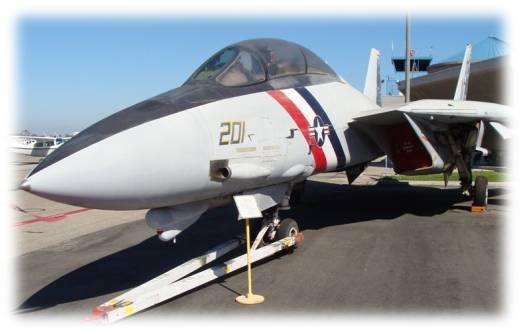
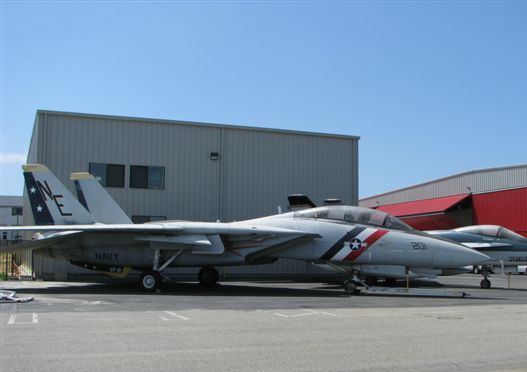
This F-14 hails from the Top Gun School at
Miramar
Specifications:
Length...........62ft 8in 19.10m
Height...........16ft 0in 4.88m
Wingspan....64ft 1.5in 19.54m (unswept)
38ft 2.5in 11.65m (swept)
33ft 3.5in 10.15m (overswept)
Weights.........40,104lb 18191kg (empty)
58,715lb 26632kg (clean take off)
70,764lb 32098kg (max take off)
74,349lb 33724kg (max weight)
Powerplant....2 Pratt & Whitney TF30-P-414A turbofan engines,
each rated at 20,900lb thrust (in afterburner)
Fuel.................16,200lb 7348kg (internal)
3,800lb 1724kg (external)
Range..............2,000m 3220km (max range)
765m 1231km (combat air patrol range)
Specifications of the different F-14 variants that
were produced between 1969 and 1992. Grumman produced some 710
F-14's with the last one being an F-14D on 20 July 1992. One
F-14 variant is not specified below, the original F-14B with
Pratt & Whitney 401 engines.
|
Type |
F-14A |
F-14B (F-14A+) |
F-14D |
|
First Flight |
21 Dec 1970 |
Sept 1986 |
Mar 1990 |
|
Wingspan (unswept) |
64 ft 1.5 in |
64 ft 1.5 in |
64 ft 1.5 in |
|
Wingspan (swept) |
38 ft 2.5 in |
38 ft 2.5 in |
38 ft 2.5 in |
|
Length |
62 ft 8 in |
62 ft 8 in |
62 ft 8 in |
|
Height |
16 ft |
16 ft |
16 ft |
|
Wing Area |
565 sq.ft. |
565 sq.ft. |
565 sq.ft. |
|
Empty Weight |
40,104 pounds |
41,780 pounds |
43,735 pounds |
|
Max. Weight |
72,000 pounds |
74,349 pounds |
74,349 pounds |
|
Powerplants |
2 P&W TF-30-P-414A |
2 GE F-110-GE-400 |
2 GE F-110-GE-400 |
|
Max. Thrust |
34,154 lbs |
56,400 lbs |
56,400 lbs |
|
Wing Loading |
92 psf |
94 psf |
96 psf |
|
Max. Speed |
1,544 mph |
1,544 mph |
1,544 mph |
|
Mach 2.38 |
Mach 2.38 |
Mach 2.38 |
|
Ceiling |
50,000+ ft |
53,000+ ft |
53,000+ ft |
|
Range |
1,730 nm |
2,050 nm |
2,050 nm |
|