The P51 is the most famous of the American WWII fighters.
Its design specifications like the P-38 were based upon the British
requirements for a new fighter. North American Aircraft
agreed to produce the first prototype only 4 months after signing
the contract in April 1940. By the end of 1941, the first
Mustang was delivered to England for test flights. The design
incorporated a low drag airframe and laminar flow wings.
The British version used a Rolls-Royce Merlin engine replacing
the original Allison engine, while the U.S. version used the
Packard-built Merlin.
The Merlin-powered P-51Bs first entered combat over
Europe in Dec. 1943 as high-altitude escorts to B-17s and B-24s.
By the end of the war, P-51s had destroyed 4,950 enemy aircraft
in the air, more than any other fighter in Europe.
Mustangs served in nearly every combat zone,
including the Pacific where they escorted B-29s to Japan from
Iwo Jima. 14,855 Mustangs were built of which 7,956 were P-51Ds.
During the Korean War, P-51Ds were used primarily for close support
of ground forces until withdrawn from combat in 1953.
The P-51’s
had a large fuel capacity and with the addition of disposable
external fuel tanks could range upwards of 2,000 miles, the full
operational distance for most bombers. The P-51D with its
bubble-top canopy was perhaps the best-known version of the Mustang.
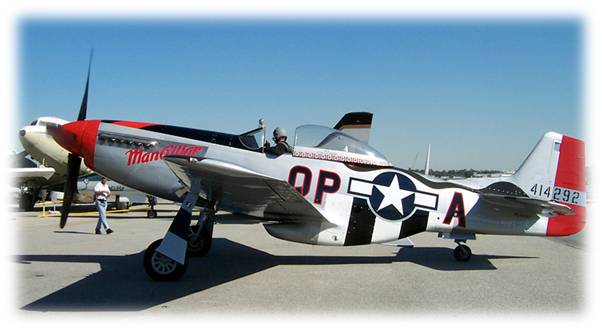
The P-51D Mustang
“Man 0' War”, tail number 44-72739, is a restored air-worthy
aircraft owned by Elmer Ward. The Mustang was built in the North
American Aircraft factory in Inglewood, California on February
15, 1945 and was immediately shipped to England in March of 1945
to the fighter pool at Stanstead. With the end of hostilities,
it was returned to the States where it was assigned to the New
Jersey Air National Guard until it was reclaimed by the Air Force
during the Korean War. Again, with no first line use for the
P-51D, it went back into the Guard until it was declared surplus
in 1956. Universal Studios acquired the aircraft as a prop
for the movie " Battle Hymn". The entire cockpit was
stripped along with everything forward of the firewall.
Up until 1971, when Universal held an auction to get rid of its
excess movie props, the aircraft sat in the back lot deteriorating.
It was purchased in 1971 by Ascher Ward. In 1975, Elmer
Ward ( no relation to Ascher ) purchased the partially restored
aircraft and fully restored it to its present condition using
the authentic 4th Fighter Group paint scheme, of Kinnard's “Man
0' War”. “Man 0' War” is an exact duplicate
right down to the very rare Spitfire mirrors on the windshield.
Following the restoration, “Man 0’ War” was painted
on the aircraft by Don Allen who painted the name on the original
“Man 0’ War” during WWII.
The North American
P-51 Mustang
Manufacturer
North American Aircraft Inglewood California
Number Built
7,956
Wing Span
37 ft. 0 in.
Overall Length
32 ft. 3 in.
Overall Height
13 ft. 8 in.
Speed (Maximum)
440 mph.
Range (Maximum)
1,000 miles 2,125 miles
Altitude (Maximum)
41,900 ft.
Armament
Six .50-cal. machine guns and ten 5 in.
rockets or 2,000 lbs. of bombs.
Power plant
V-1650 Rolls-Royce Merlin engine built under
license by Packard (1,490hp)